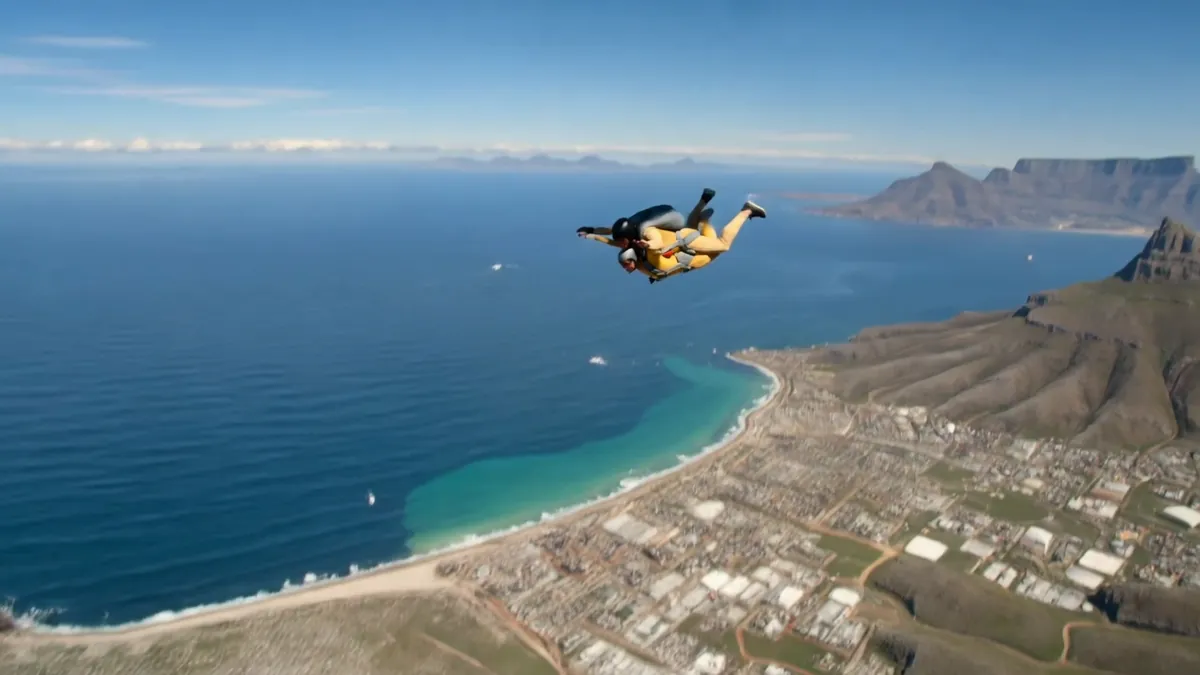
AFF Skydiving Course South Africa puts you in freefall on your very first jump, with two instructors holding the harness and letting go as you prove you can hold a position and pull on time. It runs as a ground school day and then a set of numbered levels, each one a jump with its own tasks. It is the fastest route to jumping alone and the dearest per jump. Say when you can get to a drop zone and compare priced quotations.
Super easy & fast
- See the ground school and the levels priced separately, so you never pay too much.
- Send the same details to several schools, and quotes come back fast.
- From LEADERR APPROVED providers, vetted and backed by many verified 5-star reviews. Peace of mind that the instructors are rated for the level they teach.
Say when you can train, and get course quotes.
Get the Best QuoteAFF Skydiving Course Prices
Ballpark figures so you can check a quotation.
| Item | Ballpark price |
|---|---|
| Accelerated freefall ground school | R3,500 - R6,500 |
| Level with two instructors, per jump | R2,200 - R3,400 |
| Level with one instructor, per jump | R1,600 - R2,600 |
| Full course, ground school and all levels | R18,000 - R32,000 |
| Repeated level, per jump | R1,600 - R3,400 |
| Consolidation jump after the levels | R250 - R450 |
| Student gear hire, per jump | R150 - R350 |
| Association membership, per year | R1,200 - R2,400 |
Prices JUST UPDATED. Ballpark figures, rounded, excluding VAT. They reflect typical South African drop zone, school and club rates. They are not our prices or quotations, and no provider is bound by them. A skydive is quoted on the EXIT ALTITUDE and on who jumps with you, so confirm what each quotation includes, such as the height you exit at, the instructors on the jump, whether video and stills are in the figure, whether gear hire is, and what a repeated jump costs.
How the Course Is Built
- Ground school. A full day on gear, exits, body position and emergencies.
- The early levels. Two instructors on the harness from exit to pull.
- The middle levels. One instructor, and turns and stability to demonstrate.
- The late levels. Released on exit, tracking and a solo dive flow.
- Consolidation. Cheap solo jumps that build the numbers for a licence.
What Each Level Jump Costs You
- Instructor time. Two of them early on, which is the bulk of it.
- The lift. Full altitude every time, because you need the working height.
- Student gear. A rig sized to you, charged by the jump.
- The debrief. Video review and a signed logbook entry.
- A repeat if you miss a task. Charged the same as the first attempt.
What Decides How Fast You Finish
- The weather. Students are held to tighter wind limits than licensed jumpers.
- Aircraft availability. A small field runs fewer lifts a day.
- How often you can come. Gaps mean a refresher before the next level.
- Your own consistency. Repeats are normal and they are what stretch a budget.
- Daylight. Student jumps are daytime jumps.
Get a price for the full course rather than a range.
Get the Best QuoteWhat Affects the Price
- How many instructors are on the jump. Two costs close to twice one.
- How many levels you repeat. The single biggest variable in the total.
- Whether gear hire is bundled. Ask for the figure with it included.
- Whether you pay up front. A block price usually beats jump by jump.
- Which drop zone. Lift prices differ by aircraft and altitude.
- How long the course drags out. Refresher jumps are charged like levels.
What to Include in Your Request
- When you can train. Consecutive days finish faster and cost less.
- Where you are. Suburb and town, so you get schools within reach.
- Your weight. It decides the student canopy and sometimes the aircraft.
- Any jumps you already have. Tandems and static line jumps both count for something.
- Whether you want the whole course quoted. Rather than the ground school alone.
- Your budget shape. Up front or per jump, which changes the rate.
Before You Book an AFF Course
- Ask for the all in figure. Ground school, every level, gear and membership.
- Ask what a repeat costs. Most students repeat at least one level.
- Ask how many lifts a day run. It decides how fast you can move through.
- Ask who your instructors are. Ratings and how long they have taught.
- Ask about the refresher rule. How long a gap triggers one, and what it costs.
- Ask what happens after the levels. Consolidation jumps are the cheap part.
AFF Skydiving Course FAQs
How much does an AFF course cost in South Africa?
Commonly R18,000 to R32,000 for ground school and all the levels, with the ground school alone R3,500 to R6,500 and a level jump R1,600 to R3,400 depending on how many instructors are on it. Repeats and gear hire are extra.
How many jumps is an AFF course?
The course itself is a set number of numbered levels, then consolidation jumps on your own to build experience. Most people also repeat a level or two, so plan for more jumps than the syllabus lists.
Is AFF better than a static line course?
It teaches freefall skills from the first jump and gets you to solo jumping in fewer jumps, which is why it costs more per jump. Static line spreads the cost and takes longer. Both end at the same licence.
Do I need a tandem before starting AFF?
Not usually, though some schools recommend one so your first look at freefall is not also your first level. It is a cheap way to find out how you react before committing to a course.
What happens if I fail a level?
You repeat the jump and pay for it again. Repeating is routine rather than a setback, and it is the main reason a course runs past its quoted price, so ask for the repeat rate when you ask for the course.
An accelerated freefall course is quoted in pieces by every school, and Skydiving Cape Town is the quickest way to compare the totals rather than the levels.
Related Services
Get the Best Quote, Fast
Client Reviews
Powered by leaderr